Peptide Journal: Two Weeks In — Relearning Ease After Years of Force
In this two‑week update on my retatrutide journey, I reflect on what it’s been like to explore peptides through the lens of surgical menopause. I share early observations around appetite, fullness cues, hydration, sleep, and subtle physical changes — while centering the deeper emotional and nervous system shifts that have mattered most. More than weight or numbers, this update focuses on what it feels like to move from forcing outcomes to creating safety in the body, releasing the “hard way” identity, and learning to trust support again after medical trauma. This post is personal documentation, not medical advice, and is offered as a nuanced, real‑world perspective for women navigating metabolic changes after surgical menopause.
2/10/20263 min read

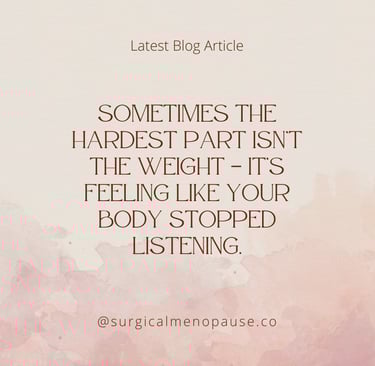
For many women in surgical menopause, the hardest part isn’t just weight gain — it’s the quiet belief that your body has stopped responding no matter how hard you try.
You follow the plans.
You lift the weights.
You regulate your nervous system.
You do everything “right.”
And still… nothing moves.
What begins to erode isn’t just confidence — it’s trust in your own body.
Two weeks into my retatrutide journey, the most meaningful shift hasn’t been on the scale.
It’s been this:
I’m beginning to experience what it feels like to pursue change without force.
A Different Internal Experience
Instead of constant food noise and vigilance, I’m noticing something many people describe but I didn’t fully understand until now — quiet.
Less mental energy around food.
Feeling full sooner.
Eating with more intention instead of pressure.
There have even been moments where I’ve had to consciously remind myself to eat — especially to stay on track with my protein goals. That alone has shifted how I relate to nourishment.
Not restriction.
Not control.
Just… space.
And in that space, I’m beginning to feel something I haven’t felt in a long time:
Relief.
Letting Go of the “Hard Way” Identity
One of the most powerful realizations during these two weeks has been recognizing how deeply I believed change had to come through struggle.
That if it wasn’t difficult, it wasn’t earned.
That pushing harder was the only path forward.
This experience is challenging that identity.
I’m learning that support does not mean weakness.
That tools can exist alongside discipline.
And that healing sometimes looks like allowing rather than forcing.
This is very aligned with the work I teach — creating safety in the body so change can happen from regulation instead of stress.
Physical Observations So Far
Early observations are still just that — early — but here’s what I’ve noticed:
Appetite and fullness cues have shifted significantly
I need to be more intentional about hydration than before
Hitting protein targets requires conscious planning due to reduced hunger
The scale reflected a 2.5-pound decrease after the first week
Subtle changes in waist definition are beginning to reappear
Sleep has remained mostly stable, though I did experience some nighttime reflux that may have been related to progesterone timing rather than the peptide itself. I’m continuing to observe patterns with curiosity rather than assumption.
Mood and nervous system response have remained emotionally neutral and steady — which, for me, is valuable data in itself.
The Real Transformation So Far
Yes, there are physical changes.
But the deeper shift is internal:
Moving from forcing outcomes
to creating safety.
Moving from constant monitoring
to listening.
Moving from believing my body was resistant
to allowing the possibility that it simply needed different support.
And that shift alone feels incredibly freeing.
What I’m Watching Moving Forward
As this journey continues, I’ll be paying close attention to:
Long-term appetite signaling and nutritional balance
Hydration needs and inflammation patterns
Nervous system regulation and emotional steadiness
Strength, muscle retention, and recovery
Sleep and hormone interactions
Changes specific to surgical menopause symptoms
Closing Reflection
Two weeks in, I don’t feel “fixed.”
I feel curious.
Grounded.
And cautiously hopeful.
More than anything, I feel like I’m learning to relate to my body from trust instead of constant effort — and that, for me, is already a meaningful shift.
If you’re following along, I’d love to know what you’re curious about or what you’d like me to observe as this journey continues.
Disclaimer
This series is a personal documentation of my individual experience exploring peptides within the context of surgical menopause and my existing health practices.
It is not medical advice, treatment guidance, or a recommendation for any specific protocol. Every body responds differently, and my experience is shaped by my personal health history, lifestyle, and professional lens.
If you are considering any medical therapy or peptide, please work with a qualified healthcare professional who understands your individual needs.
My intention in sharing is to offer honest, real-world reflection through the lens of nervous system awareness and individualized healing.
Surgical Menopause Wellness
Empowering women through surgical menopause resources and wellness practices.
Disclaimer
The information provided on this website is for informational and educational purposes only and is not intended as a substitute for professional medical advice, diagnosis, or treatment. This content should not be used to diagnose, treat, cure, or prevent any health condition or disease. Always consult with a qualified healthcare provider before making any changes to your health regimen, starting new treatments, or if you have questions regarding a medical condition. Reliance on any information provided by this website is solely at your own risk.
© 2024. All rights reserved.