Post-Hysterectomy and Oophorectomy Care: How to Find a Doctor Who Understands Surgical Menopause - 9 Questions that could change your care
Struggling to find a doctor who understands surgical menopause, post-hysterectomy care, or oophorectomy recovery? Learn the 9 essential questions to ask before choosing a provider, plus how to advocate for yourself, evaluate your appointments, and find a healthcare provider who truly listens.
6/2/20263 min read
The 9 Questions Every Woman Should Ask Before Choosing a Surgical Menopause Doctor
If you’ve ever left a doctor’s appointment feeling dismissed, unheard, or more confused than when you arrived, you’re not alone.
Many women navigating surgical menopause, post-hysterectomy care, or post-oophorectomy care find themselves searching for answers, only to discover that not every healthcare provider has the training, experience, or understanding needed to properly support them.
I know because I’ve lived it.
After my own experience with surgical menopause, I went through more than ten providers looking for someone who truly understood what I was experiencing. Some were kind. Some were well-intentioned. But many simply didn’t have the knowledge or experience to recognize the severity of surgical menopause symptoms or understand how dramatically the sudden loss of ovarian hormones can impact a woman’s body and quality of life.
The result?
Years spent feeling terrible when I didn’t have to.
Years spent searching for answers that should have been easier to find.
That’s exactly why I created my free guide:
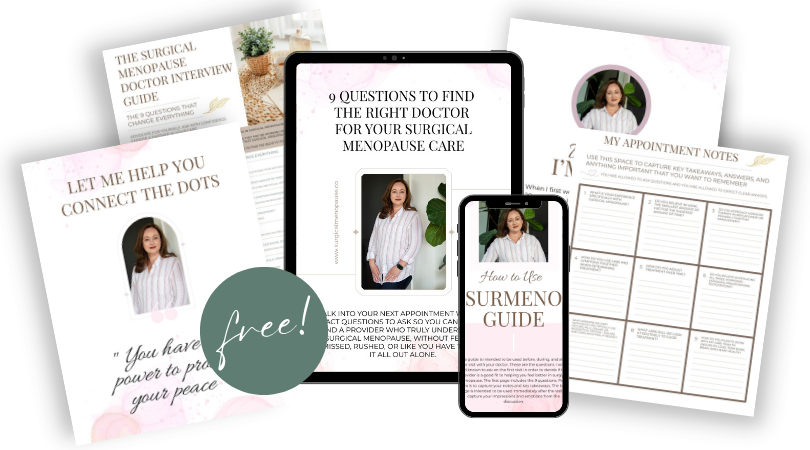
The 9 Questions to Find a Doctor Who Understands Surgical Menopause Care
This simple tool includes:
* Nine essential questions to ask any potential provider
* A notes page to bring to your appointment
* A post-visit debrief and ranking tool to help you objectively evaluate whether the provider is truly a good fit for your needs
Because finding the right doctor can change everything.
The Mindset Shift Many Women Don't Realize
One of the biggest lessons I’ve learned is that your appointment isn’t just a medical visit.
It’s also an interview.
For many women, that idea feels uncomfortable at first.
We’ve been conditioned to view doctors as the experts and ourselves as passive recipients of care. We show up, answer questions, and hope for the best.
And if that’s been your approach until now, that’s okay.
Most of us were never taught another way.
But when you’re navigating surgical menopause, post-hysterectomy symptoms, or life after an oophorectomy, finding the right provider becomes one of the most important decisions you’ll make.
You are not simply being evaluated. You are evaluating, too.
Does this provider understand surgical menopause?
Do they stay current with research?
Do they listen when you describe your symptoms?
Do they view you as a partner in your care?
These questions matter.
Because your health matters.
“Never Forget, It’s Your Body.”
One of the most important lessons about self-advocacy came from a conversation I’ll never forget.
I was at the hospital for my annual breast MRI. Anyone with difficult veins probably understands what happened next. The staff needed to start an IV for contrast, but they couldn’t get the line in. The specialist IV team had already gone home for the day.
They tried again. And again. And again.
By the time they finally succeeded, I had been stuck seven or eight times. Nearly two hours had passed. I was bruised, frustrated, and emotionally exhausted.
The next morning, I told my doctor what had happened.
She looked me directly in the eye and said something that has stayed with me ever since:
“Never forget, it’s your body.”
What she meant wasn’t that I should be difficult.
She wasn’t encouraging confrontation.
She was reminding me that I have a voice.
That I have a right to ask questions.
That I have a right to request alternatives.
That I have a right to understand what’s happening to me.
That I have a right to feel comfortable with the care I’m receiving.
And so do you.
You have the right to discuss treatment options.
You have the right to talk openly about medication side effects.
You have the right to ask why a recommendation is being made.
You have the right to seek a second opinion.
And you have the right to find a provider who aligns with your goals and values.
The Right Provider Changes Everything
Finding a doctor who understands the nuances of surgical menopause, hysterectomy recovery, and oophorectomy care is not a luxury.
It’s a foundational part of your healing journey.
The right provider can help you feel heard.
They can help you understand your options.
They can help you make informed decisions.
And perhaps most importantly, they can help you stop feeling like you’re navigating this journey alone.
That’s why I created this guide.
It’s the shortcut I wish someone had handed me years ago.
A practical tool designed to help you identify providers who understand the unique needs of women living with surgical menopause.
Because the sooner you find the right support, the sooner you can stop searching and start feeling better.
If you’re looking for a provider who understands surgical menopause, post-hysterectomy care, or life after an oophorectomy, this guide will help you walk into your next appointment with confidence.
Inside you’ll find the nine essential questions to ask, a convenient notes page, and a simple debrief tool to help you evaluate whether a provider is truly the right fit.
Because your health matters.
Your voice matters.
And your care should be a partnership.
Never forget:
It’s your body.
Surgical Menopause Wellness
Empowering women through surgical menopause resources and wellness practices.
Disclaimer
The information provided on this website is for informational and educational purposes only and is not intended as a substitute for professional medical advice, diagnosis, or treatment. This content should not be used to diagnose, treat, cure, or prevent any health condition or disease. Always consult with a qualified healthcare provider before making any changes to your health regimen, starting new treatments, or if you have questions regarding a medical condition. Reliance on any information provided by this website is solely at your own risk.
© 2024. All rights reserved.